
If you’ve ever felt that one side of your body is stronger, more flexible, or more coordinated than the other, you’re not imagining it. Every human being is asymmetrical. We all have a “dominant” side, and we all develop small differences in how we move, stand, and use our bodies.
Most of the time, these differences are harmless. But when they grow too large—or stack up over time—they can influence how efficiently you move, how resilient your joints are, and even how likely you are to experience pain or injury.
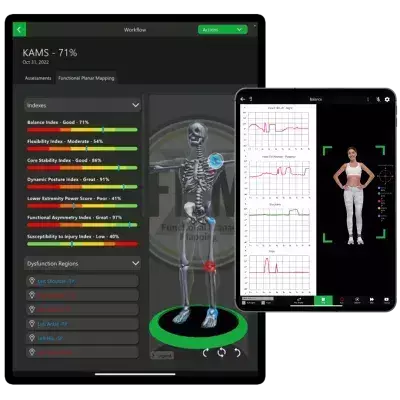
At our clinic, we use Kinetisense 3D motion analysis to identify these patterns clearly and objectively, so you can understand what your body is doing and how to improve it. Let’s break it down.
What Are Movement Asymmetries?
How Your Nervous System Shapes These Patterns
Asymmetries aren’t just about muscles and joints. Your brain plays a major role in how your body moves.
Motor Control Patterns: Your brain becomes efficient at what you repeat. If you always twist, reach, or stand on one side, your nervous system reinforces that pattern.
Protective Patterns After Injury: Pain changes how the brain organizes movement. Even after tissues heal, the brain may continue to “protect” one side, creating long‑lasting asymmetries.
Sensory Awareness (Proprioception): Your brain relies on sensory feedback to know where your body is in space. If one side sends clearer signals, that side becomes easier to control and stabilize.
The good news? The nervous system is highly adaptable. With the right treatment and exercises, it can relearn balanced, efficient movement.
When Asymmetry Becomes a Problem
Not all asymmetries are a problem. But they can become an issue when they are:
- Too large (big differences in mobility, balance, or strength)
- Too numerous (several small issues stacking together)
- Ignored over time (leading to compensation and overload)
Research shows that certain asymmetries—especially in ankle mobility, grip strength, and dynamic balance—are linked to higher injury risk.
How Asymmetries Affect Your Movement
When one area moves differently, the rest of the body adapts. Over time, this can lead to:
- Overuse on one side
- Increased stress on joints
- Reduced balance and stability
- Slower recovery from injuries
- Recurring pain patterns
The encouraging part: most functional asymmetries can be improved with targeted treatment and better movement awareness.
How a Kinetisense Scan Helps
Kinetisense is our 3D motion‑capture system that gives us a clear, objective picture of how your body moves. It helps us identify neurological and functional compensations across four key areas:
- Posture - How well your body aligns from head to toe.
- Range of Motion - How far your joints move in different directions.
- Balance & Stability - How steady and controlled you are during standing and movement.
- Movement Patterns - How your body works together during everyday motions like bending, reaching, or squatting.
Kinetisense can also assess gait, fall risk, post‑concussion changes, and other complex movement patterns.
How We Use This Information in Your Care
A Kinetisense scan isn’t just a snapshot—it’s a roadmap.
- Initial Scan: We identify dysfunctional patterns and set treatment priorities.
- Treatment & Exercise Selection: Your care plan—adjustments, soft‑tissue therapy, and corrective exercises—is tailored to your unique movement profile.
- Progress Tracking: Repeat scans show what’s improving and what still needs work.
- Outcome Documentation: Your improvements are measured and recorded—useful for return‑to‑sport, work clearance, personal training, and long‑term health tracking.
The Bottom Line
Movement asymmetries are normal—but they’re also meaningful. Understanding them gives you the power to move better, feel better, and prevent future issues.
A Kinetisense scan helps us see what your body is doing beneath the surface, so we can guide you toward stronger, more balanced, more efficient movement.
If you’re curious about how your body moves—or you’re dealing with pain, stiffness, or recurring injuries—this is one of the most valuable assessments you can do.
Whenever you’re ready, we’ll walk you through it. Call us for an appointment.
Biography:
Dr. David Olson, DC: Dr. Olson has over 45 years of experience treating back pain, neck pain, and sports injuries in North Vancouver. He is the founder of Edgemont Chiropractic Clinic and is passionate about combining the latest research with hands-on care to help patients move and live pain-free. When he's not in the clinic, Dr. Olson enjoys staying active on the North Shore. He practices at Edgemont Village in North Vancouver, BC.

Dr. David Olson
Contact Me
.jpg)
%20(Website).jpg)
